What Makes a Dress Look Expensive? It Is Not the Price

The secret to looking expensive has surprisingly little to do with what you spend—and everything to do with what you notice.
There are two kinds of women at a dinner party.
The first walks in wearing an unmistakably expensive dress. You notice the label, the accessories and perhaps the price you have already mentally calculated.
The second arrives in something deceptively simple.
No obvious logos. No determined attempt to impress. Just a beautiful silhouette, elegant shoes and that almost irritating ability to make everything look effortless.
Somehow, she is the one you cannot stop looking at.
Fashion may adore a status symbol, but women with genuinely good style understand something more interesting: money can buy a dress, but it cannot buy an eye.
The difference between a garment that costs a fortune and one that simply looks exceptional often comes down to a handful of details. The cut. The texture. The proportions. The finishing. The way every element appears to belong.
So, what makes a dress look expensive?
It is not the number on the receipt. It is the impression that nothing was left to chance.
An expensive-looking dress has a clear point of view
You know the dress.
It has a dramatic neckline, elaborate sleeves, oversized buttons, unexpected cutouts and perhaps a decorative bow making a late bid for attention.
Individually, each detail may be lovely. Together, they are having a very loud conversation.
Sophistication rarely comes from adding more. It comes from deciding what deserves attention.
Consider a beautifully cut ribbed knit dress. There may be no elaborate construction visible to the eye, but the line is flattering, the proportions feel balanced and the fabric moves naturally with the body.
The Valeria blush pink ribbed knit midi dress takes this softer approach. Its streamlined shape and gently flared skirt allow the silhouette to remain the focus.
The Alessia scarlet red ribbed knit midi dress makes a bolder entrance, yet the principle is the same. Scarlet is hardly a shy color, so the clean silhouette gives it room to speak without competition.
One dress whispers. The other enters the room first.
Neither needs to shout.
Fit is the first luxury signal
A beautiful dress in the wrong fit can look ordinary. A simple dress in the right fit can look extraordinary.
When a garment fits well, the effect is almost invisible. You notice the woman rather than a seam pulling across her hips or fabric gathering awkwardly at the waist.
The shoulders sit naturally. The waist falls in the right place. The hem creates a flattering proportion. Nothing appears to be fighting with anything else.
This is especially important with elegant knit dresses because the fabric follows the body more closely than many woven materials. A fitted knit should skim rather than strain, and the silhouette should remain composed as the wearer moves.
The Roxane navy blue knit maxi dress demonstrates how much proportion contributes to polish. Its long, fitted line is balanced by a defined waist, romantic collar and controlled front slit. The details may catch the eye, but the silhouette gives them authority.
Never underestimate the difference of a small alteration, either. A slightly shorter sleeve or carefully adjusted hem can transform the way a garment sits.
The label tells you which size you bought.
The fit tells everyone how carefully you dress.
Texture creates visual richness
Have you ever seen two dresses in almost the same color and silhouette, yet one looks infinitely more luxurious?
Often, the difference is texture.
Fine ribbing, pointelle patterns, crochet accents and tweed-inspired knits catch the light and give the eye something to explore. They create depth without relying on a loud print or excessive embellishment.
The Niovi powder blue crochet-trim knit maxi dress illustrates why contrast can be so captivating. Powder-blue knit meets black crochet trim, giving the dress a distinctive graphic finish.
It is feminine, but not predictable—and that distinction matters.
The Odalys burgundy tweed-knit cardigan and skirt set creates a richer mood through its deep color, diamond texture and contrasting trim. It recalls the composed elegance of classic jacket-and-skirt dressing without simply reproducing a traditional suit.
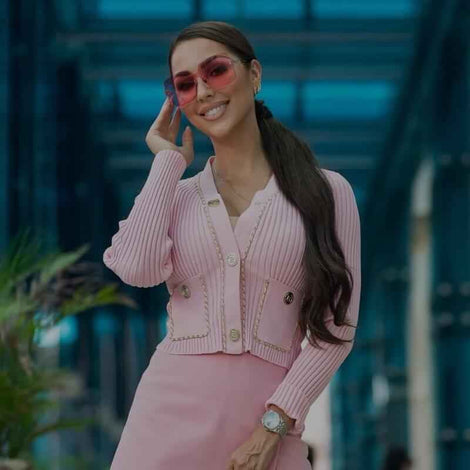
The Odile pink tweed-knit cardigan and skirt set takes a softer approach. Blush pink, textured knit and gold buttons create a look that is unapologetically feminine.
And who decided femininity needed to be toned down before it could qualify as sophisticated?
Certainly not us.
Beautiful details should belong to the same story
A shaped collar. A row of gold buttons. A narrow contrasting trim. A perfectly placed bow.
Sometimes the smallest details make a piece memorable. The secret is that they should appear to belong together.
On Roxane, the dark knit silhouette, light organza collar, ivory cuffs and pearl-and-crystal accents create one coherent mood. The result feels romantic and refined, with just enough vintage influence.
The Adeline pink pointelle cardigan and skirt set embraces a more expressive kind of femininity. Openwork knit, contrasting trim, gold buttons and delicate decorative accents all contribute to the same idea rather than competing for control.
This is where styling restraint becomes important. A cardigan with an embellished neckline probably does not need a dramatic necklace. A dress with decorative gold buttons may need only small earrings and a structured handbag.
And a bow already making a charming statement does not need three more bows offering moral support.
An expensive-looking outfit does not necessarily have fewer details. It has better relationships between them.
Hardware can change the entire impression
Buttons, buckles and embellishments occupy very little space, yet they can determine whether a garment feels distinctive or disposable.
The Black and Gold knit cardigan and maxi dress set uses metallic-dot jacquard and gold lion-head buttons to create a coordinated evening look. The hardware continues the mood of the fabric, so it feels integral rather than added at the end.
The Burgundy studded knit cardigan and pleated skirt set repeats gold ball studs at the cuffs and waistband. That repetition creates rhythm and gives the complete outfit a deliberate finish.
For evening, the Vesper black crystal-button lace-knit cardigan and skirt set introduces light through crystal buttons and lace panels. The Black sequin knit belted cardigan takes a subtler route, using shimmer within the texture rather than placing all the drama on the surface.
Good hardware catches the light.
It should not hijack the room.
Color can look every bit as luxurious as a neutral
There is a particular version of expensive-looking style that the internet seems determined to prescribe.
Camel coat. Cream trousers. Beige sweater. Structured brown handbag.
Beautiful? Absolutely.
The only path to sophistication? Hardly.
Deep burgundy, midnight navy, powder blue, blush pink and scarlet red can look every bit as refined. What matters is whether the color feels intentional.
A bold red dress looks polished when the silhouette remains uncomplicated and the accessories are restrained. Powder blue gains definition from a crisp contrasting trim. Burgundy feels rich when paired with texture and controlled gold accents.
The most successful outfits establish a clear color hierarchy. One shade leads; everything else supports it.
Choose the star before the accessories begin auditioning for the role.
A matching set creates instant cohesion
There is something deeply satisfying about a matching set.
Perhaps it is the pleasure of getting dressed in minutes and still appearing as though the outfit received considerable thought. Perhaps it is simply the relief of never asking whether the top really works with the skirt.
When a cardigan and skirt share the same texture, palette and finishing, the result looks cohesive. Cohesion is one of the quiet reasons an outfit appears more expensive than its price.
A coordinated set is also more versatile than it first appears. Worn together, the pieces create one polished line. Separately, the cardigan can accompany tailored trousers or dark denim, while the skirt works with a refined blouse or simple fitted knit.
That versatility is a better measure of value than the number of pieces hanging in a wardrobe.
The most useful clothes are not necessarily the ones worn most loudly. They are the ones that continue finding reasons to be worn.
Restraint is the final ingredient
Even an exceptional dress can lose its polish through careless styling.
Visible undergarment lines can interrupt the silhouette. Too many statement accessories can make every detail less effective. A garment that pulls or bunches will never look tailored simply because it is tight.
Occasion matters, too. Sophistication is not only knowing what looks beautiful. It is knowing what feels right, where and when.
Before leaving the house, step away from the mirror and look at the complete outfit rather than each individual item.
Does the silhouette feel balanced?
Is there one clear focal point?
Do the shoes, bag and jewelry belong to the same story?
Would you still love the outfit without knowing the label?
If something feels wrong, resist the urge to add another accessory. The smartest styling decision may be to remove one.
The real luxury is knowing what suits you
The women who always appear impeccably dressed do not necessarily have the largest wardrobes, the newest collections or the most expensive handbags.
They understand themselves.
They know which silhouettes make them feel beautiful, which colors bring life to their complexion and which details reflect their personality. They also know which trends are better admired on somebody else.
Personal style is not about collecting everything beautiful. It is about recognizing what is beautiful for you.
Once you understand that, the way you shop begins to change.
You look beyond the label. You notice proportion, texture and finishing. You stop asking whether a dress looks expensive enough and start asking whether it looks extraordinary on you.
Because style has never been about proving how much you spent.
It is about showing how well you chose.
And good taste does not come with a price tag—but you can always tell when a woman has it.